17 April 2018

SAMSON'S CASHEW MARKET REPORT - 17 APR 2018


Cashew kernel prices came down significantly during March with some processors selling W320 as low as 4.25 FOB for prompt and nearby shipments. Prices have moved up a few cents during April but still lower than the levels traded during Jan/Feb. Differential between the lowest and highest offer at any given time has widened considerably.

Current range of prices is W240 from US$ 4.75 to 5.00, W320 from US$ 4.40 to 4.85, W450 from US$ 4.35 to 4.60, SW from US$ 4.30 to 4.50, Splits from US$ 4.15 to 4.40 and LP from US$ 3.50 to 3.75 FOB

RCN prices also declined during March - lowest levels were 200-300 dollars lower than the highs of Jan / Feb. Now, prices seem to have bottomed out and there is a slight pick up in the last 2 weeks. Current prices are in the range of US$ 1900 to 1950 for IVC, around US$ 2000 for Ghana, around US$ 2050 for Benin and US$ 1900-2000 for other origins (Burkina, Togo, Conakry etc)

The current RCN prices are lower than the peaks of Nov 2017 - Feb 2018 but higher than the range in which majority of the 2017 crop was traded.

The current kernel prices are lower than the peaks of mid 2017 and near the bottom of the range traded during 2017.

As noted before, RCN prices have moved up about 60-70% in the last 3 years where kernel prices have moved up only 30-35%

Overall, supply of kernels in 2018 is likely to be the same as 2017. Vietnam & Cambodia will have bigger crops than they have had in last 2-3 years but the earlier expectation of huge crops in these 2 origins has been tempered down from 600-650K to about 450 or max 500K. There is some concern about crop in some areas of India. No adverse news from West Africa but kernel yields are certainly lower than normal at this stage of the crop. This is a trend we have been seen for the last few years - African crops are bigger but kernel yields are lower.

Vietnam has been slow in buying in West Africa. One reason is the higher purchases from Tanzania in the last quarter of 2017 coupled with bigger crops in Vietnam & Cambodia. Other is reluctance of processors to pay the very high prices quoted in Feb / early March in the face of slow kernel market. Large processors have been buying in the declining market. In the last couple of weeks, there are signs of more processors starting to buy.

Indian processors have bought reasonable quantities in West Africa mainly because low purchases in East Africa meant stocks were low. They will probably continue to buy if prices remain around current levels.

Kernel buyers have been comfortable with their strategy to buy small quantities for nearby shipments as prices have been coming down. As there is no concern on supply, they have not felt the need to take any large forward covers - especially when the processors are asking significant premiums for deliveries beyond couple of months.

The fact that not much kernel business has been done for second half 2018 shipments is a double edged sword. It means that processors will need to sell at regular intervals to maintain inventory & cash flow levels. It also means that buyers will have to buy at regular intervals to have enough product to deliver to roasters and roasters to retailers. The problem could be if the RCN prices do not come down further (or go up) without an increase in kernel prices 0r kernel activity. Processors would reduce RCN buying and this could result in reduction of conversion & kernel availability for some periods although RCN availability may be okay.

We have seen more than once that cashew market can do what very few expect, BUT Our feeling is that in the coming weeks, RCN prices will stabilise around current levels or move up a bit. If that happens, processors will be forced to increase kernel prices as their margins are already under pressure with current prices. And that may lead to an increase in kernel activity if buyers see the market turning.

Although we do not expect prices to move up too much, we would not be surprised if W320 are trading around the high of the current range. Unless something big happens, downside is limited.

Pankaj N. Sampat

Source: SAMSONS TRADERS

19 March 2018

Ghana to stop exporting raw materials – Osafo Marfo

Mr. Yaw Osafo Marfo, Senior Minister, has hinted at plans by government to halt the export of raw materials from Ghana to enrich other economies. “There will be no export of raw materials from this country. Government is determined that we are going to have value addition to our raw materials to create employment for our own people,” he said.

Mr. Marfo said this on Thursday at Batsona during the inauguration of the Tema West Municipal Assembly which was carved out of the Tema Metropolitan Assembly (TMA).

Observing the effects that the exported raw materials has had on Ghana, he said, “We cannot have a situation in which our raw materials are used to create employment for people elsewhere whilst our people live in poverty.”

He said, “We want jobs for our people. The number one problem we have in Ghana today is unemployment, but we always export our raw materials unprocessed for them to process which brings a lot of revenue and create jobs for their people.”

“So government has resolved that it won’t allow the export of these materials without adding value to them here in Ghana”.

He said some countries had such a law, and that the government was currently looking at a draft legislation which would demand that all raw materials in Ghana should be processed before exported.

05 March 2018

What Happens to the Cashew Sector If Vietnam Strictly Enforces Import Quota?


At present, Vietnamese initiative to control the import price of global raw cashew has no takers in India.

According to some trade sources, the first goal of a cashew factory is to reach a safe stock level. India needs huge imports at this stage as the summer holiday season is fast approaching. Ramadan month will start from May 15, which is the second highest consumption period in India after Diwali.

But we think that the production cut of 50000-tonne in kernel terms; if strictly regulated will reduce 15-17% in raw cashew imports.

A better harvest also reduces the dependence on costly imports.

So the total reduction in Vietnam’s raw cashew import may be 250000-300000 Tonnes by the year-end. Another addition to this figure is the ‘global level year on year increase’!

04 March 2018

Vietnam pause to import Raw cashew nuts due to high prices


According to Dang Hoang Giang, Vice President of Vinacas, the price of raw cashew nuts in Africa has been blown. Specifically, the price of raw cashew nuts increased 30-40% while the price of cashews on the world market increased only about 10-15%. In 2017, the average price of imported raw materials is $ 1,956 / ton, the highest ever.


End-of-season crude prices in Africa are also rising in the first two months of the year. Due to the high price of raw cashew nuts, Vietnamese companies have temporarily stopped importing raw cashew nuts. Indian businesses have also made similar moves. Facing this situation, many forecasts show that, from March 15 onwards, the price of raw African rice will have to drop.


However, Ta Quang Huyen, Chairman of the Board of Hoang Son 1 Co., Ltd. said that even if the price of raw materials has decreased, Vietnamese enterprises do not need to import too much raw as 2017 ( over 1.3 million tons) with just 900,000 tons to 1 million tons.


According to Mr. Huyen, this year, weather conditions are quite favorable for cashew and fruit trees, so it is likely that the cashew in Vietnam will reach a good yield, can reach 400,000 to 500,000 tons. Similarly, the Cambodian cashew has many advantages, which can help Vietnamese cashew producers reduce import pressure from Africa.


Due to the volatile material situation, Vinacas and its member businesses have agreed to increase the quantity, focus on processing and develop the domestic market. Accordingly, the cashew industry targets to export cashew nuts in 2018 to 300,000 tons, instead of 362,700 tons as in 2017. This corresponds to a turnover of $ 3 billion in 2018, lower than 3.62 billion dollars compared with the previous year.


Setting up "reverse" as above may cause the agency to be dissatisfied. However, "In addition to reducing the price of raw materials to buy a reasonable level of about $ 1,800 / ton, the industry is no longer reducing prices. Therefore, if trying to increase export turnover in 2018 to $ 4 billion by purchasing materials at high prices as of 2017, the business only left a loss. In fact, we can not affect the selling price of cashew kernel depends on the market demand, "said Nguyen Duc Thanh, chairman of Vinacas.


In order to shorten supply and demand for raw materials for processing, Vinacas is cooperating with the Cambodian Ministry of Agriculture, Forestry and Fisheries to develop raw material areas, aiming to increase output to 1 million tons in the next 10 years. /.

13 February 2018

Kerala: Private cashew processors stare at huge losses


With around 400 cashew factories in Kollam district remaining closed due to a variety of reasons including high operational costs leading to accumulating losses, small scale private cashew processors are at the receiving end. Many cashew processors are now facing revenue recovery procedures from the banks due to default in mortgage payments. Recently, a cashew processor who incurred a huge loss from his factory was on the verge of suicide and was saved at the nick of time.


A cashew processing unit owner hailing from Chandanathoppe in Kollam attempted suicide as he face revenue recovery threats for his debt to the tune of Rs 7.5 crore from the Karnataka Bank. Five factories under his company Alfana cashews remain shut for more than a year now, which was a source of livelihood to some 800 employees. Another processor from Randam Kutty in Kollam having a default of Rs 4.5 crore has been served with revenue recovery notice asking to repay the money within a month’s time from the Corporation Bank.


“Several cashew factories are on the verge of revenue recovery proceedings owing to the financial crisis they are in. The industry is not at all profitable in Kerala when compared to neighbouring states. For processing a bag of 80 kg cashew here, it will cost nearly `2,000 more than other states like Tamil Nadu, Karnataka, and Andhra Pradesh. The government should immediately intervene by announcing financial packages modelled on other industries,” said I. Nisamudeen, secretary of federation of cashew processors and exporters.


The private owners are also denied sufficient time to repay dues as the debt is listed as a non-performing asset (NPA) soon after the completion of 90 days of non-payment. At present, the banks charge an interest rate of 9%-12% from the processors which could be included as a financial package with the intervention of the government. Proper repayment schedule in long term and availability of new working capital from banks could save the sinking industry.

01 February 2018

Vietnam’s path to become world cashew king

A worker examines cashew nut after preliminary processing (Photo: SGGP)

Vietnam has overcome India, the world’s largest and long standing cashew nut processing and export nation for 12 years, and now continues leaving the country far behind to become the new capital of the world’s cashew processing industry.

Nearly a decade ago, the cashew processing industry took shape in India and its city Kollam became the world’s cashew capital. By the end of the 1990s, India including Kollam entered the most golden phase, exporting 97,000 tons of cashew a year accounting for 80 percent of the world’s total processing output.

After 1975, Vietnam started exporting raw cashew nut. The country’s cashew processing industry started to toddle in early 1980s when the Government encouraged businesses to export peeled instead of raw cashew nuts.

Since the Government encouragement the industry had begun to become one of the most earners and recruited most unskilled workers, contributing to create jobs for rural laborers.

However after industrial zones were set up in many provinces and cities especially in the southeast region, which was considered as the capital of Vietnam’s cashew industry, garment and textile field started developing and became the most attractive industry to laborers.

Workers gradually left cashew peeling plants for garment and textile companies. The situation put the cashew industry in front of a decisive turning point to invest in machines and equipment to replace the scarce laborers.

A group of engineers from HCMC Export Farm Produce Company led by Mr. Nguyen Van Lang, who is considered to be the father of the Vietnam’s cashew processing industry afterwards, started studying a technology to cut cashew nut shells and grained initial successes in 1984.

The technology’s price accounts for only 10 percent of import items. However, Mr. Lang and the group was just able to transfer the technology to businesses in Song Be province (Binh Duong and Binh Phuoc provinces now), and Long An province until the end of the 1980s under the huge pressure from laborer scarcity.

Ten years later, up to 60 plants used the technology which was continued being popularized later on. The technology has taken Vietnam from a raw cashew nuts exporter to become one of leading nations in exporting peeled product.

Spectacular change


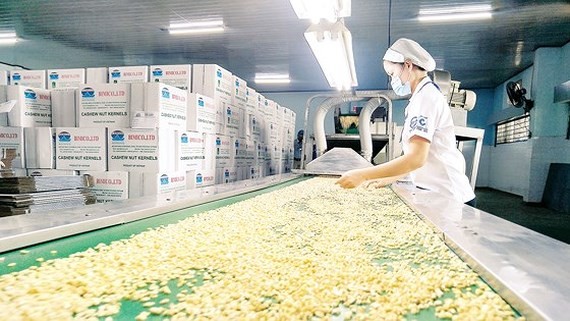
Workers at a cashew nut processing plant (Photo: SGGP)

Statistics from Vietnam Cashew Association (Vinacas) show that Vietnam started exporting cashew nut to China in 1992 and the US in 1994. Two years later, the country began importing raw cashew nuts from Africa to process and terminated export of raw cashew nuts to India.

From 2002 to 2003, the Vietnam’s cashew industry posted development leaps to become the world’s second largest cashew production, processing and export nation. In 2006, the country outstripped India to become the world’s top exporter.

Year of 2007 witnessed a strong change in technical investment structure and cashew processing technology especially in the phase of automatic shelling which Vinacas continued improving in 2009 and 2010. Vietnam obtained the export turnover of $1 billion for the first time in 2010.

From only a group of Mr. Lang studying cashew processing technology initially, there were as many as 13 domestic mechanical engineering companies attended an equipment showcasing event organized by Vinacas in Binh Duong province in 2012. They comprise Khuong Viet, Anco Viet, Son Viet, My Anh An , Phuc Thang, Gia Loi, Tien Loc Phat, Viet Le Nguyen and Thanh Son.

Over 80 percent of equipment at cashew processing plants have been made by domestic firms. That is the result of national program KC07 implemented in 2006-2010 to study applications and develop technologies for industrialization and modernization.

The entire of 13 phases in cashew processing have been fully or partly mechanized, reducing nearly 80 percent workers.

Nearly 500 international businesses attended the cashew conferences in Vietnam to learn about business opportunities in the end of 2017,

Early December 2017, The Wall Street Journal published the article “How Cashews Explain Globalization,” saying that today Vietnam is the cashew king thanks to an ingenious push to automate the business. Kollam is reeling, a victim of misguided government protectionism and its own unwillingness to adapt to the realities of the freewheeling global economy.

25 January 2018

Cashew businesses worry about high price trap in 2018

Cashew businesses worry about high price trap in 2018-Vietnam

Although global cashew demand is predicted to continue rising, the Vietnam Cashew Association (Vinacas) and cashew processors and exporters are worrying about a high price trap which may affect their activities in 2018.

   A cashew processing factory


Vinacas Chairman Nguyen Duc Thanh said the association is concerned about unpredictable prices as cashew nut export prices may fall sharply after they already hit record last year. Meanwhile, raw cashew prices are still high at present.

Cashew nut export prices averaged 10,000 USD per tonne in 2017, rising by over 20 percent from the previous year. They have declined by 10 percent after reaching their peak last June.

Some businesses said with current export prices, raw material prices should be lower than 1,900 – 1,950 USD per tonne so that production and business activities are profitable.

However, raw cashew prices in the global market are currently about 2,100 – 2,150 USD per tonne. Producers will suffer losses if they buy materials in bulk at present.

Thanh said businesses should be alert for a high price trap since they might purchase raw materials at very high prices but sell cashew nuts at lower prices. A similar situation happed in 2000. Therefore, companies should balance raw material and processed nut prices to ensure profit.

Many insiders also forecast 2018 would be a bad year for cashew processing and export.

Ta Quang Huyen, Chairman of the Hoang Son 1 Co. Ltd, said that on January 1, many foreign supermarkets increased the prices of cashew nut products by 15 percent from 2017.

He said if selling prices are too high, consumers will gradually switch to other types of dried nuts. The price hike could slow cashew nut consumption, especially in the last six months of this year.

Facing unpredictable prices, Vinacas and cashew businesses decided to reduce cashew nut output and export revenue in 2018 so as to improve quality and expand the domestic market.

They will reduce the processing output from 350,000 tonnes in 2017 to 300,000 tonnes in 2018 and the cashew nut export turnover from 3.5 billion USD to 3 billion USD this year.

According to the Ministry of Agriculture and Rural Development, Vietnam earned 3.52 billion USD from shipping 353,000 tonnes of cashew nuts abroad in 2017, up 23.8 percent in value and 1.9 percent in volume from the previous year. The country made up over 50 percent of total global cashew nut export value in 2017 and remained the world’s top processor and exporter of this product.-VNA